Gates of Olympus Dice Slot
The least known member of the series. The symbols became dice faces; the skeleton of the game was left exactly as it was.
The Gates of Olympus Dice Demo
See the symbols redrawn as dice faces on a virtual balance. The reel structure and tumble logic stay exactly as they are elsewhere in the series.
Gates of Olympus Dice is the least discussed member of the series, and its reason for existing is different from the others. The change here was not made to enrich the player experience but to fit the regulatory structure of particular markets. The result is a familiar game in an unfamiliar skin.
What Is the Dice Edition?
In short: the same game with symbols redrawn as dice faces. The grid is still six columns by five rows, there are still no paylines, eight matching symbols are still enough. Winning symbols burst, new ones drop in, and the chain keeps producing payouts for as long as it holds.
The visual layer, however, has changed completely. Gems and jewels give way to dice faces, the interface is adapted to the theme and the palette is rebuilt. On first launch it can take a moment to recognise that this belongs to the Olympus series at all.
The maximum win stays at the base-edition level, around 5,000x. Multiplier orbs also remain in the familiar 2x to 500x range. This is not, in other words, a strengthened edition like 1000.
Why Dice Versions Exist
The answer lies in regulation rather than game design. In some countries dice games are classified separately from slot machines, with their own licensing, tax and advertising rules. A market closed to slot titles may be open to dice titles.
Providers fill that gap by producing dice-interface counterparts of their popular releases. Pragmatic Play’s dice series came about exactly this way, and Gates of Olympus Dice is part of it.
The practical consequence is that availability depends on geography. The same operator may list this title in one country and not in another. If you cannot find it in a catalogue, that is usually why.
How the Dice Format Differs From Slots
From a player’s point of view there is no practical difference: same grid, same payout rule, same tumble chain. The distinction sits entirely on the regulatory side and comes down to what the symbols look like.
In some jurisdictions the law classifies games by the visual theme that presents the outcome. A game played with dice faces falls into the “dice game” category, and that category carries its own licensing, tax and advertising rules.
Providers use that distinction to offer the same engine in two shells. Gates of Olympus Dice is a textbook case: the core logic preserved, the symbol set redrawn, the game now listable in a different category.
The only consequence that reaches the player is availability. There is no sense in which the game becomes “easier” or “more generous” — a category name does not shift probabilities.
What Changed in the Interface
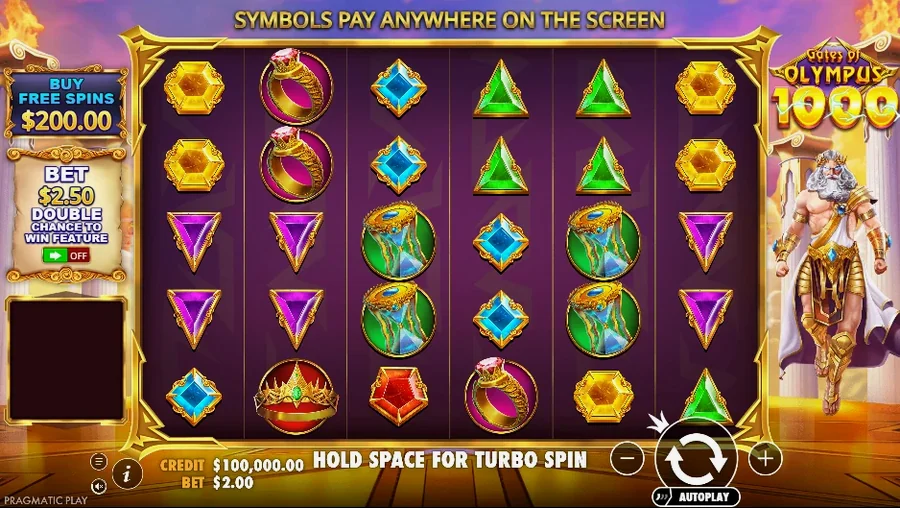
Dice keeps this skeleton; only the artwork inside the cells changes.
The screen alongside shows the standard reel structure of the series — the Dice edition inherits that skeleton untouched. What changed is the artwork inside the cells.
The symbol hierarchy is preserved: the ordering from highest payer to lowest follows the same logic, with only the icons converted to dice faces. Opening the paytable once to see which face sits at which tier is all it takes.
Scatter and multiplier orbs were adapted to the theme as well, but their functions are unchanged. Orbs are still summed when the chain closes and applied to the round’s win.
Is the Maths Really the Same?
The core structure is: grid, payout rule, tumble chain and bonus logic all line up with the rest of the series. Some caution is warranted, though — the paytable and multiplier range of dice adaptations can differ slightly between operators.
The reason is that these titles are offered under different regulatory regimes. A configuration valid in one market may have been adjusted in another. It is a more pronounced version of the RTP-configuration difference seen elsewhere in the series.
Make it a habit: when you open the game, press the info button and read the paytable and theoretical return once. It takes thirty seconds and tells you exactly which configuration you are playing. The same advice applies across the series — we explain why in the RTP section of the editions page.
The Bonus Round and Multipliers in Dice
The bonus mechanic works on the same logic as everywhere else. Enough Scatters on screen start the free spins, orbs landing through the round accumulate into a shared total, and that total applies to every new win. Three more Scatters add five spins.
Orb values stay in the base-edition range of 2x to 500x. There is no raised ceiling of the kind the 1000 edition carries, so the upper limit of a bonus round also stops around 5,000x. The dice theme has no effect on any of these numbers.
The buy bonus option appears at some sites, again priced at 100 times the total bet. But because regulators in the markets where dice adaptations are offered restrict that feature more often, finding the button missing is entirely normal. Where it is absent, the rest of the game runs as usual.
Where to Find It
Distribution is limited. While the base edition and 1000 appear in almost every licensed catalogue, Dice is listed only by operators serving particular markets. Searching for it can therefore take a little more effort than the others.
The quickest route is to filter the catalogue by provider and pull up the Olympus titles together. Typing “dice” into the search box works too, since the provider’s other titles in that series are listed under the same keyword.
If it is not there, the alternative is simple: the base edition, which offers the same mechanics in the standard interface, is available everywhere. Apart from the dice theme you miss nothing, because the tumble chain and multiplier system at the heart of the game work identically in both.
A Checklist Before You Play
- Open the info screen. The theoretical return and maximum win are written there. Because those values can diverge between operators in dice adaptations, this check matters more here than in the other editions.
- Read the paytable once. Knowing which dice face sits at which tier makes the grid much easier to read. The ordering is familiar, but the artwork is entirely new.
- Check whether buy bonus exists. If the button is missing that is not a fault, it is the regulation of that market. Ante Bet is usually still present.
- Set your stake on base-edition logic. Since the ceiling and multiplier range match, the stake level you use in the base game applies here too.
Who the Dice Edition Suits
This edition makes sense for two kinds of player. First, those who simply prefer the dice theme — seeing dice faces instead of slot symbols is a more enjoyable experience for some. Second, players in markets where the slot format is not offered and this adaptation is the only route available.
Switching to it in search of a mathematical advantage, on the other hand, serves no purpose. The ceiling matches the base edition, the multiplier range matches, the bonus logic matches. If you want higher variance and a bigger cap, the 1000 edition is the right address; if you want the bonus more often, Super Scatter is.
Questions About the Dice Edition
Questions about why this dice adaptation exists and where it can be found.
What is Gates of Olympus Dice?
It is Pragmatic Play’s adaptation with a dice-themed interface. The reel structure, the eight-symbol rule and the tumble logic are preserved; the symbols are redesigned as dice faces. Mechanically it sits very close to the base edition of the series.
Why does a dice version exist?
In some countries dice games are regulated as a separate category from slots, with their own licensing conditions. Providers build dice-interface counterparts of their popular slots to reach those markets. The reason is regulatory, not a design decision.
Is the payout structure the same as the base edition?
Largely yes — the same grid, the same eight-symbol rule, the same tumble chain. Dice adaptations can, however, show small differences in paytable and multiplier range between operators. Checking the values in the game’s own info screen before playing is the safe approach.
What is the maximum win?
It sits at the base-edition level, around 5,000x. There is no raised ceiling here of the kind the 1000 edition carries. Multiplier orbs also stay in the familiar 2x to 500x range.
Is it available at every site?
No, this is the most narrowly distributed title in the series. Whether it appears in a catalogue depends on the market the operator serves. If you cannot find it, that is not a fault — it simply is not offered at that site.
Does the dice theme make the game easier?
No. The theme only changes how the symbols look; probabilities and payout logic are independent of what a symbol resembles. Seeing dice faces does not make outcomes any more predictable.
How does the bonus round work?
On the same logic as the rest of the series: enough Scatters start the free spins, orbs accumulate through the round and the combined multiplier applies to each win. Round length and retrigger rules are familiar as well.
Is there a demo version?
There is, and the player on this page opens it. It runs from Pragmatic Play’s own demo server on a virtual balance. A few spins are enough to see the interface change and how the symbols were redrawn.
Related Pages
Open the gates of Olympus yourself
Zeus can drop a multiplier orb on any spin. Learn the mechanics in the free demo first, then play at a stake that suits your budget.